From manager to senior leader: what really changes
Discover how to become the leader your next role requires [9 min read]
If you’ve been in your managerial role for a while, you’ve likely mastered your territory. But when you prepare to move up, you naturally start asking what will be different there:
What will be expected of me to be entrusted with a senior role – and to succeed in it?
And what can I do now to make sure I’m ready when the opportunity comes?
Nowadays, it’s easier than ever to find lists of executive competencies. At the same time it’s much harder than ever to develop them without becoming overwhelmed – or neglecting your current responsibilities.
This article explores how you can begin practising the shifts that senior leadership requires within your current role, without having to wait for the title or step outside your existing responsibilities.
So that when the right opportunity comes, you not only feel ready for it, but have already given people reasons to recognise you as ready.
Perhaps the biggest misconception about moving into senior leadership is that you are expanding your territory. You are entering a different dimension of leading.
So what actually changes in senior leadership roles?
Managers often approach senior leadership as a bigger version of the job they already have. More responsibility, bigger team, bigger targets, bigger decisions. That’s because we tend to think about career growth in terms of levels and scope.
But to understand this transition, I find it more useful to think of it as a different dimension of leading – with different dynamics and demands.
So rather than simply doing more, the transition may call for exploring how you could lead differently: with a different focus, a different use of authority, and a different way of relating to people, decisions and the work itself.
And you can begin exploring that dimension by approaching everyday situations differently, gradually expanding your presence in the wider territory.
Because executive readiness is not a fixed state – it is your capacity to transform how you show up, respond and relate – with more awareness and intention.
That transformation can – and ideally should – start within your current role.
And while the change becomes visible in how you lead, it is also underpinned by an internal shift. You may know that you need to act with more authority, influence or strategic perspective, yet still find something holding you back. Many managers experience that.
This is where the mindset and leadership identity become important.
In the sections that follow, we’ll look at how you can start shifting them in three core dimensions of executive readiness:
- scope of responsibility
- level of influence
- strategic thinking
Executive readiness develops through consciously evolving your mindset and identity as you change how you respond to everyday business situations.
From managing people to influencing systems
Going back to the expansion that comes with a senior role, this is often what threatens managers most.
Yes, your “territory” expands: you become responsible for wider systems, influence more senior stakeholders and need to set direction with the bigger picture in mind.
But true change doesn’t happen on the axis of size – it happens on the axis of gravity.
As your scope expands, not everything carries the same weight. Some decisions, relationships and conversations have far greater consequences for the business than others.
The shift is therefore learning to sense where your influence matters most – and to place your attention, judgement and authority there.
In other words, you become more skilled at deciding where it actually matters to take the business and its people.
That is what changes when your leadership becomes systemic: you are no longer simply managing what falls within your territory. You are learning to recognise what carries weight across the wider system – and where your contribution can make the greatest difference.
Here’s what that can look like in practice.
To expand our capacity for responsibility, we need to understand how our own system responds when that happens – and experience that we can handle the discomfort.
From managing delivery to conducting the system
Seniority if often associated with broadening your scope of responsibility. Yet if you look at how senior leaders deliver results, their role starts to look less like doing the work themselves and more like conducting an orchestra.
They are not responsible for every individual deliverable. They are responsible for helping the whole system work well – sensing what is happening across it and knowing where the emphasis needs to fall.
In business terms, this means gradually developing your “ear” for:
- what is happening beyond your own team
- how different teams and decisions affect one another
- what the business may need beyond the results we are delivering today
- where your attention and intervention can have the greatest impact
It starts with noticing the interconnectedness of what we do: the interplay between your team’s work and other teams, between your decisions and their consequences for your manager and the wider organisation, and between today’s choices and what they may shape tomorrow.
But there is a psychological shift underneath this.
While you can begin practising this in your current role, many managers struggle to see themselves as someone who could actually be conducting this orchestra.
Why? Because greater responsibility also means accepting that you cannot control every outcome.
Consider what happens when your team takes a course of action and it fails. How does it make you feel? What does it make you think about yourself?
Setting direction and taking responsibility for things that matter inevitably involves the possibility of getting things wrong. To expand our capacity for responsibility, we need to understand how our own system responds when that happens – and experience that we can handle the discomfort.
You can start by asking yourself:
- What am I comfortable being responsible for?
- How does it feel to assume full responsibility when something goes wrong?
The answers can reveal where your next leadership shift may need to happen.
That takes us to another dimension of senior leadership: influence.
To take an influential position, you first need to trust yourself enough to put your judgement forward.
From relying on authority to creating ownership
Here again, we tend to think of influence as something we need to expand across more levels. As your seniority grows, you do need to navigate more layers of business interaction:
Direct reports → Wider team → Associated teams → Their managers → Your manager → Their manager → Senior leadership team
But what runs through all these layers of influencing is something more fundamental: trust.
In my experience of supporting managers through this transition, the first shift is often learning to trust the value of your own contribution.
To take an influential position, you first need to trust yourself enough to put your judgement forward. This creates the inner permission to contribute and invite others to trust your direction.
From there, influence becomes less about finding a formula and more about sensing what each relationship or level needs to move things in the right direction. It becomes truly relational: trusting others.
You own your idea – you trust the seed you plant – while allowing others to become creators and owners of what grows from it.
Influence in this way is much more than persuasion – it is creating ownership. And it is something you can only really develop through practice and real interactions.
You can start exploring your relationship with trust by asking:
- What happens when I need to influence without formal authority? What assumptions might limit me?
- Which stakeholders do I feel most comfortable influencing – and which do I avoid?
- What do I trust myself to influence effectively?
- Where do I believe I can add the most value?
Trusting your own judgement also connects directly to the next aspect of senior leadership: strategic thinking.
Gradually, your role can shift from asking senior leaders what the strategy is to facilitating strategic thinking within your own area.
From knowing the strategy to thinking strategically
In simple terms, we think strategically when we use our farsight to inform our steps today.
We tend to associate it with designing the grand strategy for the organisation – something that is reserved for boards and executives. But strategic thinking deserves a more grounded definition – it needs to be brought down to earth.
A senior leader – like a conductor – connects the two ends:
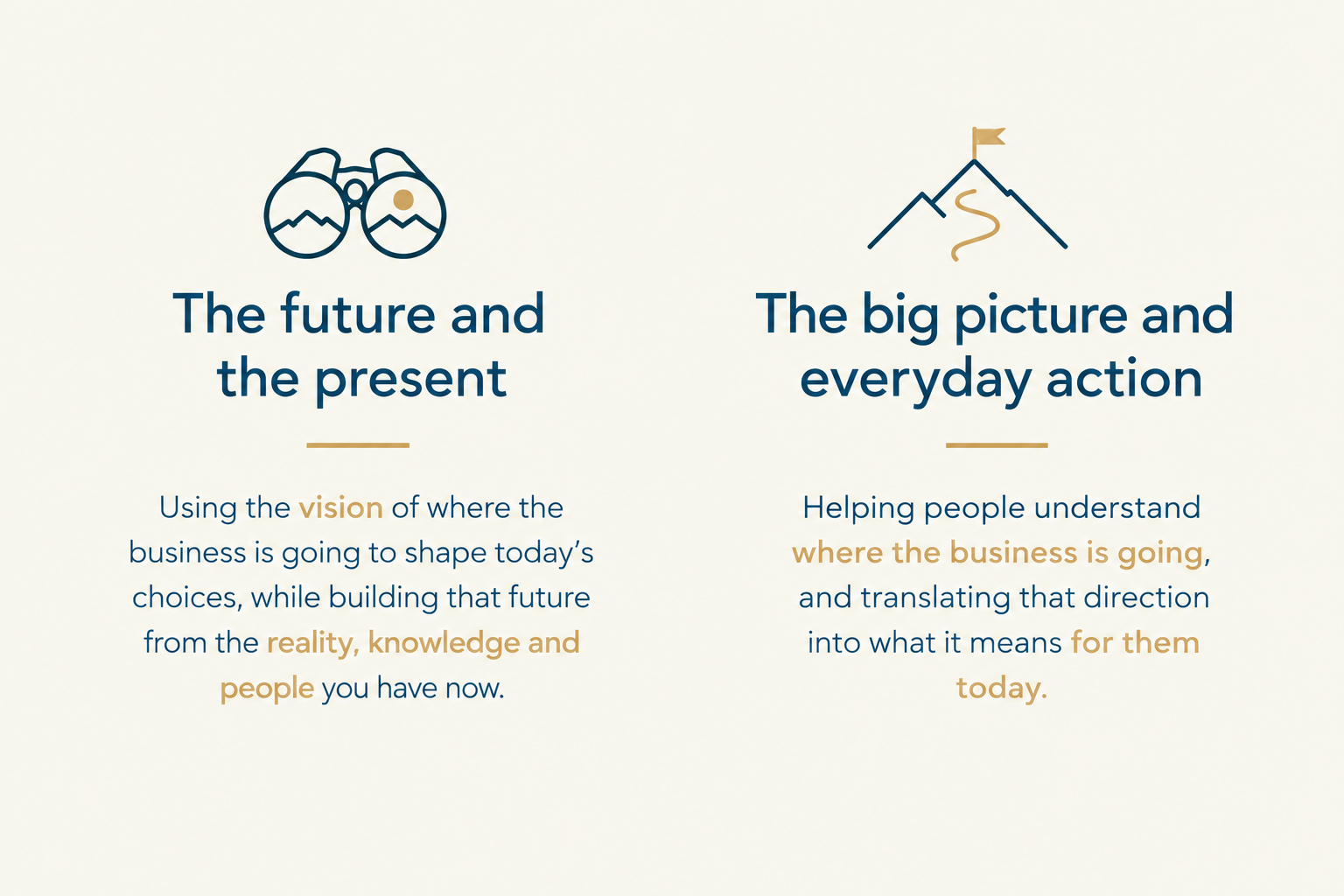
This has little to do with imposing strategy from the top. Seasoned leaders gather insight from across the business and use it to shape how strategy adapts to changing needs.
And that starts with trusting your own judgement enough to notice what the business needs to thrive – and trusting the expertise around you to help make it happen.
So, rather than trying to expand your vision into organisational strategy, start tuning your business senses:
- How will what we do today shape the business a year from now?
- What deserves our attention now?
- Where will focused effort make the greatest difference?
You can practise this in your everyday conversations across teams. Gradually, your role can shift from asking senior leaders what the strategy is to facilitating strategic thinking within your own area.
You get better at strategic thinking by practising it from the ground up.
Becoming ready for senior leadership starts with how you lead today.
How to start becoming that leader in your everyday job?
Start with being more selective and intentional about where and how you engage.
Every situation in your current role can be an opportunity to practise senior leadership. The shift begins with intentionally changing how you respond to what happens around you.
But don’t expect yourself to suddenly think or act like an executive.
You may think: “I know exactly what my team needs. But how do I start thinking about what the whole business needs?”
Rather than trying to make that leap, take it one step further:
How is my team’s delivery and success connected to other teams we depend on?
How could better collaboration between my team and those teams improve performance across the wider department?
How could I facilitate that collaboration within the strategic objectives we have now?
And if you are already doing that, take it one step further again:
What solutions could I put in place to make that collaboration work better across my area?
⸟
As you practise this in your everyday work, you may notice areas where you hold back or feel less comfortable engaging differently from how you are used to.
That is natural. The role you are preparing for – and this new way of interacting with your territory – is still something you are exploring and finding your ground in.
It may challenge your sense of psychological safety. It may trigger beliefs that make your conducting suddenly “freeze”.
Stay curious. Observe what comes up, and when.
This insight is valuable. It is not coming up to limit you; it is coming up to inform you – showing you where you may need to shift your mindset and identity in order to become the leader you are preparing to be.
About the author
Miriam Kochan is an Integrative Psychologist, ICF-certified Coach and specialist in Leadership Psychology and Executive Readiness. She works with experienced managers preparing for senior leadership roles, helping them understand and navigate the psychological, behavioural and relational shifts required at the next level.
Drawing on 900+ hours of coaching and 9+ years of international experience in career and leadership development, Miriam brings together psychology, coaching and business experience to support meaningful transitions into senior roles.